
Confronted with irreconcilable differences between the previous board and the CEO of the PIC, its governance arrangements have again come under the spotlight. But the idea that an “independent” rather than a deputy minister as chair of the PIC would solve the problem is to confuse symptoms for the underlying malaise. It is the investment mandate that matters. The National Treasury and the GEPF should take charge, with fiscal sustainability and long-run growth as the overriding imperatives. Governance reforms might help, but a better strategy would be to abolish the PIC altogether.
Introduction
The Public Investment Corporation (the PIC) today controls over a quarter of the consolidated assets of South Africa’s savings institutions.1 It does so as an independent financial service provider operating outside the public service. Yet the funds that it oversees originate entirely from tax-funded and statutory activities, and its liabilities are underwritten by the fiscus. Its investment mandate is far too wide, and its contribution to fiscal sustainability is negative.
It manages almost all of the funds of the Government Employees Pension Fund (GEPF), which is far the largest single pool of savings in the country, representing 40% of the assets of all retirement funds.
The investment mandate of the GEPF is therefore the leading determinant of South Africa’s flow of savings into meeting domestic financing needs. But despite its impressive growth in assets under management, its contribution to financing public investment has declined precipitously. Since 2003, its share of domestic marketable public debt has fallen from nearly 40% to just 16.5%.2
Evolution of the institutional arrangements
The GEPF was established in 1996 as the consolidated retirement fund for public service employees. Its contributing membership has increased from 930,000 in the mid-1990s to 1,268,000 in 2025. Assets under management have increased from 15.5% to 37.8% of GDP over this period.
While the GEPF trustees have overall accountability for the fund and its administration, its investment policy is a responsibility shared, in terms of the GEP Law, with the Minister of Finance.
Until the 1990s, investments were overseen by the Public Investment Commissioners, comprising the Minister of Finance and two other public officials, and were entirely held in government securities, municipal debt or state-owned companies.
The underlying principle was simple. The law required that government pension schemes, social security commitments, and various other public entity surplus funds or long-term trust accounts – all essentially “pre-funded” out of tax revenue, government debt, trust funds or state enterprise operations – should be invested only in public sector stock.
When the National Treasury was formed through the merger of the former Departments of Finance and of State Expenditure in 2000, both the administration and the investment functions were separated from the main department, though they initially remained within the public service.
In the 1990s, there was some diversification of pension fund investments as part of efforts to strengthen the funding position of the GEPF. Once the PIC was corporatised, the entire principle of public investment of government surplus funds was abandoned.
With effect from April 2005, the investment function shifted from the Public Investment Commissioners to the Public Investment Corporation (PIC), a juristic person created through the Public Investment Corporation Act of 2004. It takes its investment mandate not from the Minister but from its “depositors”, such as the GEPF and the UIF. In 2019 the PIC Act was amended to add local job creation, industrialisation, a capacitated developmental state and transformation of the economy and society, amongst other aims, as investment objectives.
Coinciding with the establishment of the PIC, the first meeting of the board of trustees of the GEPF was held in June 2005. It established various board committees, including an investment committee, which began an engagement with the PIC over the details of the investment mandate and how to exercise appropriate oversight.
Enhanced governance and stronger oversight of its investment portfolio have been priorities of the GEPF Board in recent years. The Mpati Commission drew attention in 2020 to PIC governance failures, mainly in the management of the Isibaya unlisted equity portfolio.3 It made various remedial recommendations, including that the corporation should be independently chaired rather than by a political office-bearer. This advice has not been followed. But a special advisory board has been established by the GEPF to oversee these investments, supported by two independent specialists. The mandates of the PIC and other equity fund managers have been revised. The GEPF has substantially expanded its administrative staff and has supported the expansion of capacity at the PIC.
There is a deeper problem, though, than the governance arrangements. If the investment mandate is not revisited, the GEPF’s asset misallocation will continue to undermine fiscal sustainability and South Africa’s economic resilience.
Growth of the GEPF since 1994
GEPF assets have increased from about 15% of GDP in the mid-1990s to over 30% since 2012.
Figure 1 illustrates the changing distribution of investments by the GEPF and other official funds since 1994. Whereas shares in companies were less than 10% of official funds’ portfolios in 1994, equity holdings have been above 50% of assets since 2010. RSA government, parastatal and municipal interest-bearing securities were over 70% of assets in 1994, declining to around 30% of the total from 2008. Foreign currency denominated investments have increased from near zero in 2000 to over 10% in recent years, mainly comprising a R260 billion holding in a single foreign fund (BlackRock).
Figure 1: Distribution of official fund/GEPF investments, 1994-2025
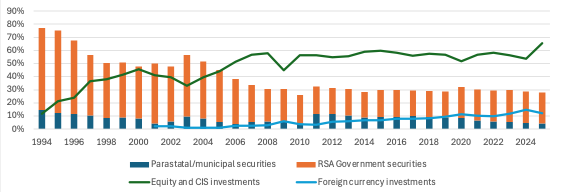 Note: Assets at market value from 2003
Sources: SARB Capital account statistics, 1994-2000; GEPF Annual Reports, 2001-2024
Note: Assets at market value from 2003
Sources: SARB Capital account statistics, 1994-2000; GEPF Annual Reports, 2001-2024
These trends reflect both the investment decisions of the PIC, as the GEPF’s investment manager, and the valuation adjustments associated with market movements in equity prices, interest rates, and exchange rates. But these trends are unpredictable, and the outcomes have been disappointing. The 2025 GEPF annual report discloses a 10-year return on investment of just 7.4%. Long-term government bond yields averaged 9.7% over this period. As financial analyst Stuart Theobald has recently argued, if the PIC fails to beat at least the state’s cost of debt, the public service retirement funding arrangement is an additional net cost to taxpayers.4
From a macro-financial perspective, the PIC’s investment policy diverts tax-generated savings into secondary market and offshore holdings. Funds have been withheld from meeting the actual financing requirements of the fiscus, municipalities and public utilities in favour of market positions with no direct association with real investment requirements.
The annual flows of funds that result from the PIC’s investment decisions, derived from the SARB’s National Financial Account, are summarised in Table 1.5
Table 1: Public Investment Corporation - Use of funds, 2021-2025 (calendar years)
| R billions | 2021 | 2022 | 2023 | 2024 | 2025 | 2021-2025 | % of Total |
|---|---|---|---|---|---|---|---|
| Cash and demand deposits | (9.0) | (13.8) | 35.7 | (31.1) | 4.9 | (13.2) | |
| Other monetary deposits | 7.8 | 10.8 | 10.3 | (13.4) | 26.3 | 41.7 | |
| Funds placed with other financial institutions | 7.3 | 16.0 | 27.1 | 56.9 | 58.1 | 165.3 | |
| Deposits and other placement of funds | 6.1 | 13.0 | 73.1 | 12.4 | 89.2 | 193.8 | 25.0% |
| Treasury bills & short term govt bonds | (6.9) | 20.5 | (6.3) | (38.1) | 4.5 | (26.3) | |
| Long term government bonds | 54.8 | 21.9 | 40.3 | 87.8 | 27.1 | 231.9 | |
| Local government & public enterprise securities | (15.7) | (3.0) | (15.9) | (3.5) | (4.5) | (42.6) | |
| Investment in public sector securities | 32.1 | 39.5 | 18.0 | 46.2 | 27.1 | 163.0 | 21.0% |
| Ordinary shares | 83.0 | 70.6 | 29.6 | 71.0 | 89.6 | 343.7 | |
| Other loans, preference shares, financial derivatives | 6.6 | 1.4 | 1.1 | 10.3 | (2.2) | 17.2 | |
| Equity and loans to business enterprises | 89.6 | 72.0 | 30.7 | 81.2 | 87.4 | 360.9 | 46.6% |
| Accounts receivable/payable | 9.5 | (0.5) | 14.5 | 11.0 | 22.8 | 57.4 | 7.4% |
| Net acquisition of financial assets | 137.4 | 123.9 | 136.3 | 150.8 | 226.6 | 775.0 | 100.0% |
| Memo: | |||||||
| Investment in public sector securities as % of total issuance | 12.6% | 21.0% | 9.6% | 12.6% | 9.9% | 12.8% | |
| Net acquisition of assets as % of gross domestic saving | 13.2% | 12.9% | 13.5% | 15.3% | 22.1% | 15.4% | |
Source: SARB Quarterly Bulletin, National Financial Account, flow of funds for the years 2021-2025.
Over this five-year period, a fifth of the PIC’s net acquisition of financial assets comprised cash or monetary deposits, or funds placed with other financial institutions (including foreign fund managers). These funds may, in part, have been invested by these intermediaries in government securities or public infrastructure, but are unlikely to have earned returns higher than from direct government bond holdings.
Direct net purchases of South African public sector securities comprised just 21% of the PIC’s use of funds for the 2021-2025 period. Net acquisition of long-term government bonds amounted to R232 billion, just over 22% of net issuance by the National Treasury. Since 2021 the PIC has reduced its holdings of treasury bills and short-term government bonds and of local government and public sector enterprise securities.
Nearly half of the PIC’s use of funds over this period consisted in purchases of shares in companies or loans and other business investments – amounting to some R361 billion. It is pertinent to note that the PIC now far exceeds the role of South Africa’s development finance institutions in managing funds intended for enterprise and infrastructure investment. Whereas these purposes could straightforwardly be served by contributing to the capital resources of the Industrial Development Corporation, the Development Bank of SA and other established institutional vehicles, the PIC has instead opted to develop its own investment capabilities. It is hard to see how this serves either institutional efficiency or policy coherence considerations. Whereas these institutions provide financial support to new investment projects, the PIC’s strategy focuses mainly on secondary market opportunities.
The PIC’s share of investment in domestic public securities has declined over time, and over the past four years amounted to just 12.8% of issuance, somewhat less than the PIC’s net contribution to gross domestic saving (or its share of domestic financing of gross capital formation). Public sector securities are now a much smaller share of the GEPF’s investment portfolio than in earlier years. Whereas in 1994 the PIC held around 29% of domestic marketable public sector debt, increasing to over 40% in the mid-2000s, since 2021 the proportion has been around 20%.
For a fund with a rising share of pensioner members, it is of concern that fixed interest securities are a declining share of the overall investment distribution. But there are also broader fiscal and financial considerations that argue for a GEPF investment mandate that prioritises South Africa’s public investment requirements.
The GEPF investment mandate
The GEP Law assigns joint responsibility for the investment mandate to the Minister and the Board for at least three broad reasons.
One is that the fiscus carries an underlying “underwriting” responsibility for the GEPF as a defined benefit fund. Allied to this is the Minister’s shared responsibility with cabinet colleagues for the conditions of employment of the public service, of which the GEPF arrangements are an integral part.
A second reason is that the GEPF’s funds, and other deposits under the PIC’s management, originate in tax-financed services and statutory commitments. These are, in effect, pre-funded commitments of the fiscus. In many jurisdictions, they are financed on a pay-as-you-go basis. In others they are partially funded. There is no one-size-fits-all solution here, but it is a fallacy to think that the PIC manages some sort of “sovereign wealth” fund that can seek to grow the nation’s prosperity beyond the fiscal capacity of a debt-constrained fiscus.
The more complex consideration is that the GEPF is so large that its investment decisions are material in macroeconomic and fiscal-stability terms. There are broad public interest grounds for the Minister to ensure that its investment mandate reflects South Africa’s macro-financial and fiscal-policy needs. For much of the twentieth century this meant that government pension funds were entirely invested, through the former Public Investment Commissioners,6 in government or state enterprise securities. Though a broader mandate might be appropriate today, the financing requirements of the fiscus are nonetheless still a critical consideration. Alongside this, it is also important that the GEPF investment mandate should reflect the potential of its leading role in intermediating between domestic savings and domestic investment and growth.
Whereas South Africa’s non-financial private corporations have since 2019 been net savings institutions, generating surplus funds some R1.6 trillion in excess of their gross capital investment, general government and public enterprises have run a R2.4 trillion net borrowing requirement. Yet, during this six-year period, the PIC has allocated a substantially greater share of its net investment to equities, rather than to domestic public sector securities.
Since 2019 the GEPF’s foreign currency investments have increased from 9.6% of total investments to 12.2%. Inclusive of secondary listings on domestic exchanges, foreign assets are equivalent to about 24% of the GEPF investment portfolio. Though global diversification has been a feature of capital market trends in recent times, we have to question the merits of this shift in the context of South Africa’s domestic investment needs.
Conclusion
It is not uncommon for small pension funds to outsource their administration and investment management to larger financial intermediaries. But scale economies are not relevant in this case. The PIC’s investment team should report directly to the GEPF Principal Officer and Board: this would make for cleaner lines of accountability than the present arrangements. The PIC’s responsibilities for managing the UIF and other funds should revert to the National Treasury, with investments limited to risk-free public securities.
The idea that an “independent” chair of the PIC will solve the investment management problem is to confuse symptoms with the underlying cause. Any pursuit, no matter how well-intentioned, of the unconstrained objectives currently set out in the PIC Act will end up in governance and conflict-of-interest challenges. The direction of reform should be towards a narrower mandate, focused on public investment financing requirements.
Given its size and macro-financial significance, the GEPF has to take the lead amongst South African fund managers in a patient commitment to long-term infrastructure investment and broad-based domestic development. This need not be limited to central government bond issues. Industrial development, infrastructure, housing and local utilities can be supported through debt issues of municipalities, water and electricity utilities, the Industrial Development Corporation, the DBSA and other development finance institutions, and through partnerships with private financial intermediaries. The specialised mandates of these institutions provide far better accountability and oversight of developmental investment management than can be expected from even improved governance arrangements of the PIC.
The bias against meeting the public sector’s borrowing requirements that we have seen in recent years is a self-defeating strategy. Contributing members of the GEPF, its pensioners, taxpayers and all South Africans share a common interest in ensuring that domestic savings are both well-governed and directed to the investment needs of our economy.
Footnotes
-
Retirement funds, life insurers and collective investment schemes (mutual funds). ↩
-
For a more complete account of the evolution of the GEPF and its investment trends, see the author’s Contractual savings and public investment: are our retirement funds misallocated? Bureau for Economic Research, 17 April 2026. ↩
-
Report of the Judicial Commission of Inquiry into Allegations of Impropriety at the Public Investment Corporation, 2020. ↩
-
Stuart Theobald, “The PIC has an identity crisis,” Financial Mail, 30 July 2026. ↩
-
The PIC’s sources of funds consist in the surplus funds it invests on behalf of the GEPF and other statutory entities. In the financial flow accounts, which are recorded at transaction values, these represent the cash surplus from operations of the PIC’s clients (contributions received less benefits paid plus investment income) plus net profit from the sale of investments, less the change in cash retained by clients. ↩
-
Until 1984, the Public Debt Commissioners. ↩


