





Downloads from this web forum are for private, non-commercial use only. Consult the copyright and media usage guidelines on www.econ3x3.org
The urban housing market has shifted: now policy must follow
Leila McKenna*, Independent Consultant and CPRE, and* Karen Harrison, the Greater London Authority
As urbanisation increases, South Africa’s cities face a housing shortfall of 2.2 million units. The traditional supply-driven model of large-scale, peripheral developments has often resulted in poor value for money and high transport costs. However, high demand for low-cost housing is driving a burgeoning market in well-located backyard apartments and small-scale rentals. These high-density developments offer economic returns and well-located housing. How must policy be reimagined to support this demand-led, “lots of small” approach and leverage the value of cities for inclusive growth?
South African city economies account for over half of national gross domestic product. Metropolitan areas house over 40% of the population. By 2030, over 70% of the population is expected to live in cities.
Cities have struggled to accommodate this rapid urbanization. There has been a dramatic increase in peripheral and marginalized informal settlements, backyard dwellings, and inner-city slums. Sprawl and poverty have increased, with new housing developments and burgeoning informal settlements increasingly far from the urban centre, making it ever more difficult for most urban residents to participate in the economy. At the same time, cities have largely failed to integrate townships into core urban transport systems.
Many policies, frameworks, legislation, and institutional resources have been put in place to restructure cities, but their impact has been disappointing. Partly, this is because of decisions and complexities at a national level, but it is also partly due to a lack of visionary leadership at the level of the city, weak city management, persistent constraints to realizing value from the property markets in lower income areas, collapsing public infrastructure, and overreliance on large projects.
The primary approach to addressing the substantial housing demand in South Africa has been to implement a housing model that is supply-driven, large-scale, construction-based, and financed mainly through subsidies for units and services. As a result of the size and densities of these projects, most have been built on the periphery of cities. They also end up producing housing of poor value for money. Dislocated from the opportunities created by cities, these developments are costly to government, individuals, and municipalities.
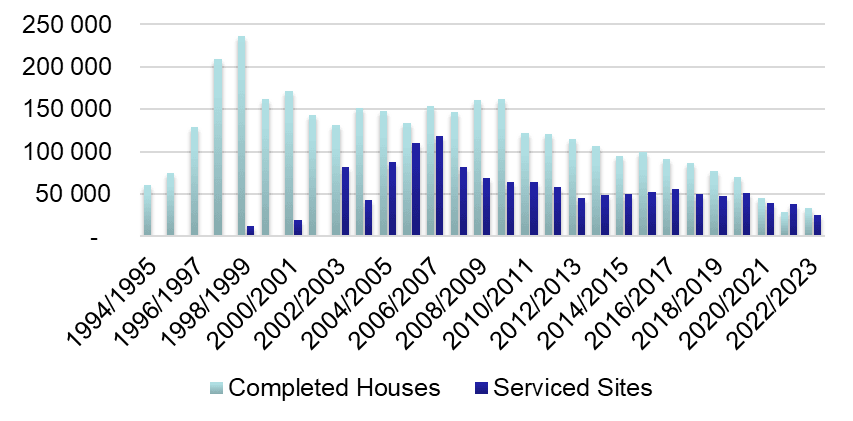
The rate of delivery across all housing programmes has seen a steep decline, leaving a current shortfall of 2.2 million households in need of formal accommodation. Source: Department of Human Settlements
This policy approach runs parallel to and to some extent contradictory to cities’ planning frameworks and national government’s Integrated Urban Development Framework (IUDF). It creates unsustainable and peripheral ‘estates’ with high maintenance costs to municipalities but no offsetting revenue flows.
The ‘lists’ of as yet unserved beneficiaries of the RDP housing programme continue to grow. Locally approved plans seem to have little bearing on national decision-making in this regard. The result is sprawl, fragmentation, lost opportunities to provide housing, and little or no progress towards inclusionary cities. Due to this urban layout, over two-thirds of households in the lowest income quintile spend between 20% - 30% of their monthly income on public transport, and this figure is increasing.
A new housing delivery model
It is time for a shift from this supply-led approach building large, low-density, peripheral settlements, to an integrated, demand-led, multi-supplier, high-density, ‘lots of small’ approach.
The small and micro housing and rental market is a fast-growing property sector, and it has considerable room to grow. In 2023, only 24% of South African households rented. Of those, only 16% were renting a flat. In other words, only 3.84% of South African households rent a flat. But the demand is high, which translates into viable investment returns. The investment returns on properties in townships are increasing above the average property markets. Annual reviews of the South African housing market by the Centre for Housing Finance in Africa show that growth has been particularly strong in the entry-level and affordable housing markets, and that government-subsidised housing (including RDP houses) has seen marked increases in median transaction prices over the past decade.
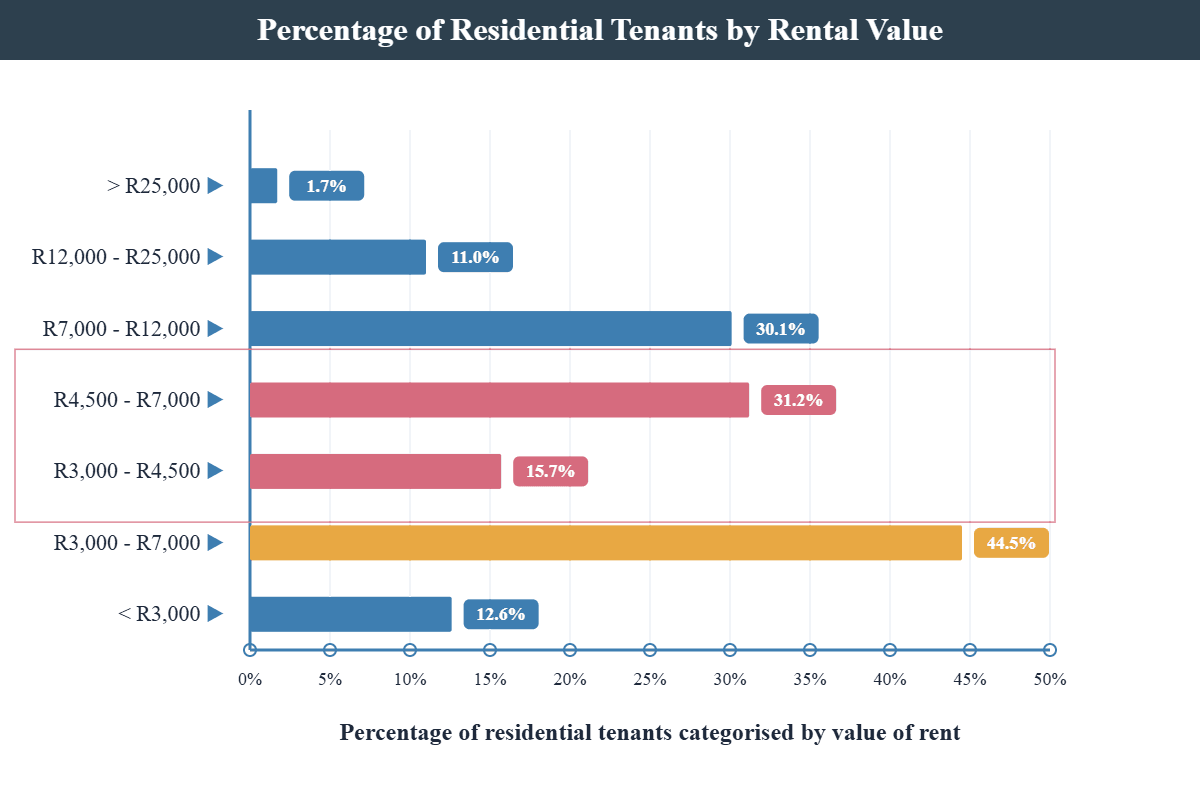
87% of units are rented at prices of less than R12 000 per month. Source: Tenant Profile Network
To turn this into a sustainable sector, adequate and expanding infrastructure and ‘ease of transacting’ is required. It is this market that is already fulfilling a critical supply, and its ability to grow is dependent on investments being made in cities, where the demand is high, and where scale of delivery and economic returns (including employment) can reduce the costs of investment. Supporting the use of property as an economic asset that can be used by poor households is dependent on addressing a range of barriers, e.g., title deeds, cost of transfers, connection fees, and new land-use management requirements that add onto the costs of transacting and limit formal processes in lower-income areas.
According to Ivan Turok and Andreas Scheba of the Human Sciences Research Council:
We have discovered a seismic shift under way in township property markets. Homeowners are showing considerable initiative by replacing makeshift shacks with bricks and mortar structures offering internal toilets and washrooms.
Other entrepreneurial individuals with some savings are also buying up properties informally and replicating this model of backyard apartments.
Private companies such as Indlu, Bitprop, Isiduli, TM Group and After 12 recognise the commercial potential by offering capital and expert help to construct flats in return for a share of the rent. They are ultimately funded by some of South Africa’s major banks.
The burgeoning supply of better-quality rental property meets the needs of many young working people who cannot afford to buy their own homes but also don’t qualify for RDP housing. Backyard flats offer more secure and dignified living environments for people who can afford to pay a modest rent (between R1,500 and R3,000 a month), but less than what is required in the formal rental market. Back-yarding is also beneficial in creating valuable work for local builders, labourers and hardware suppliers, as well as emerging estate/rental agents, and it helps to densify well-located areas and improve the viability of public transport and community facilities in these places.
Moving from segregated to inclusive cities requires targeted strategies to address land markets, entry into ownership, and transfer of wealth. One of the most impactful means of altering and transforming property markets and creating household wealth is through homeownership. The potential to build active economic assets is substantial.
‘Dead capital’ in townships
Upgrading informal settlements is a direct means of creating more inclusive cities and providing secure and affordable accommodation. Informal settlements have been an effective way for communities to provide housing. Included in the upgrading must be the formalization of tenure, ensuring household security and incentivizing investment.
There are 6.7 million residential properties on the deeds register in South Africa. Roughly one third were built by government and given to poor households as part of the Reconstruction and Development Programme (RDP) housing subsidy scheme. Roughly one million registered RDP properties are in the large metropolitan cities.
RDP properties that are formally registered on the deeds register are valued on average at over R220,000 per property. But more than a million of these houses are not registered at the Deeds Office. At an average value of R220,000 per unit, this represents R242-billion in ‘dead capital’ that would otherwise be accessible to South Africa’s poorest households.
We need to bring these transactions into the formal system, so that properties can be used as an economic asset by poor households. This involves bringing off-register transactions into the formal system, tackling the backlog of registration at the Deeds Office, and creating an affordable, accessible system for people to use in future.
A change of direction
Changing direction towards a robust housing market that can supply lower-income communities - using existing housing stock as the initial assets- will result in far greater outputs in terms of housing, jobs, and municipal revenues.
To achieve this, special attention needs to be given to:
• transferring these assets to households and issuing title deeds, bringing off-register transactions into the formal system, and tackling the transfer backlog;
• securing tenure and providing basic infrastructure and services in the case of informal settlements, which will allow communities to build their own settlements;
• escalating the delivery of social housing by increasing resources and partnering with private developers to roll out substantial housing units in strategic locations;
• supporting and stimulating the new emerging housing delivery by streamlining planning decisions, fast-tracking service connections, revoking service connection requirements, and providing high-level services and infrastructure in existing built-up areas.
As opposed to continued sprawl or linear development along corridors, this model aims to consolidate and intensify urban activity in nodes with strong transport hubs. This requires well-developed and well-managed public transport systems at city scale.
By building effective local government and creating a supportive environment for investments by households, as well as small to large businesses and existing companies, we can leverage the value of cities for inclusive growth.